A part of FEV Group
From Code to Compliance: Systems Engineering with AI Agents
Author -
FEV.io
Published -
Reading time -
7 mins
A part of FEV Group
Author -
FEV.io
Published -
Reading time -
7 mins
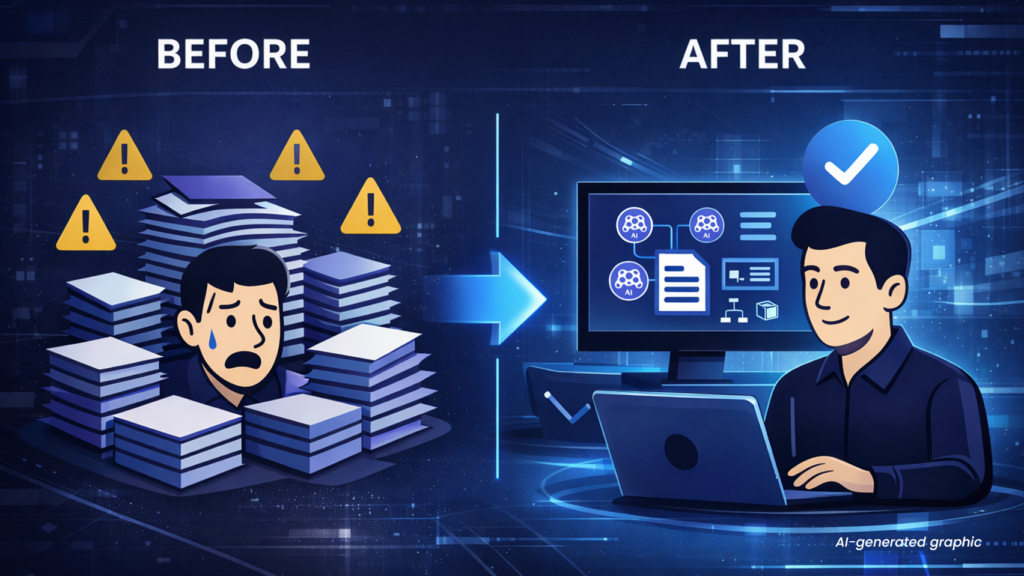
Software-defined vehicles, consolidated E/E architectures, and a wave of regulation (UNECE R155/R156 [1], the EU AI Act [2], the Cyber Resilience Act [3], ISO 26262, ISO/SAE 21434, Automotive SPICE) have compressed what engineering teams must deliver and the timelines they have to deliver it. More requirements, more architecture, more traceability, less time.
Manual Systems Engineering does not scale to meet this. A typical embedded control system contains hundreds of thousands of lines of legacy source code across hundreds of files, often with no specification documents at all. Extracting process-compliant requirements, architecture, and verification records under frameworks like Automotive SPICE or ISO 26262 takes deep domain expertise and months of effort per component.
AI agents offer a structural answer. These are autonomous systems that reason across multi-step workflows, invoke tools, and iterate toward a goal. Gartner predicts [4] that 40% of enterprise applications will embed AI agents by end of 2026, up from less than 5% in 2025. But MIT’s Project NANDA [5] reports that 95% of enterprise GenAI pilots deliver no measurable business impact. the key to sustainable introduction of AI into business process: integrated systems with structured data and human oversight succeed where one-shot prompt experiments fail.
FEV has developed two complementary approaches, one for small expert teams and one for enterprise-scale deployment.
For teams seeking maximum AI leverage with minimal infrastructure, FEV applies a Systems-as-Code methodology. SysML v2’s textual notation means system models are stored as human-readable `.sysml` files under version control. Branching, merging, diff review, and CI/CD all work natively. When models are code, they become accessible to AI agents.
All engineering artifacts, i.e. SysML-models, code, … , reside in a single git repository. Specialized agent teams execute process-compliant skills against the source code, producing structured, traceable artifacts. Every agent output passes through automated checks (schema correctness, trace-link integrity, naming conventions) before it enters the review pipeline. The engineer validates each output through a pull-request workflow with a process-aligned checklist. Nothing reaches the baseline without human approval.
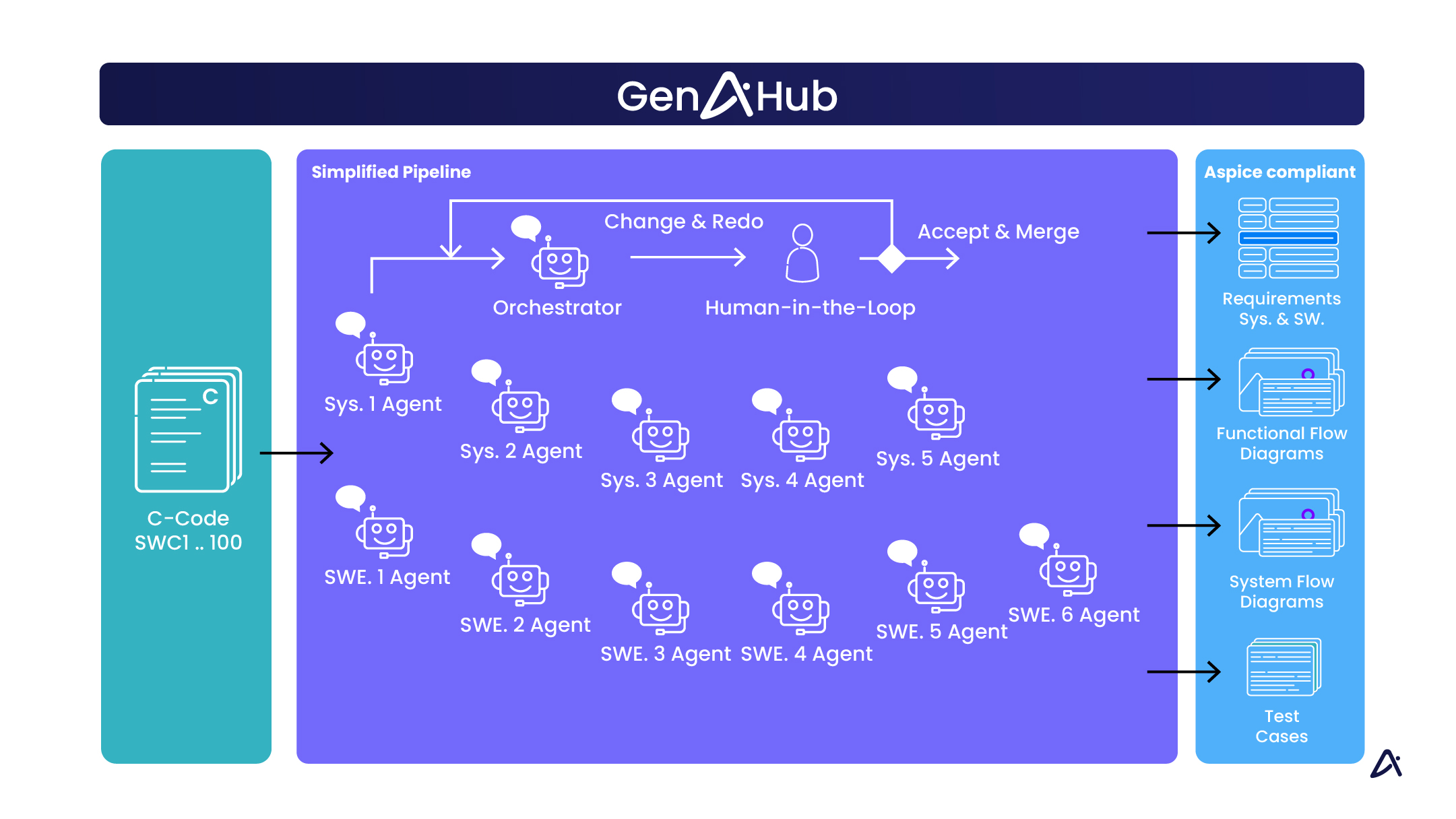
ASPICE v4.0 base practices and INCOSE [8] SE Handbook activities are distilled into eleven executable agent skills, covering SYS.1 to SYS.5 and SWE.1 to SWE.6. Multi-role agent teams (Code Analyst, Requirements Architect, Quality Reviewer) execute these skills in parallel. Accepted artifacts unblock downstream agents in a V-model cascade: SWE.1 completion enables SWE.2, which enables SWE.3, and so on through verification. The git repository serves as both orchestration backbone and de facto PLM, providing version control, audit trail, and machine-readable storage without external tool dependencies.
For larger organizations, FEV’s MBSE CoPilot provides an interactive assistant for system architects, requirements engineers, and modelers. A Chat Interface connects to a Modeling Agent orchestrated via the Model Context Protocol (MCP) [11], the open standard for AI-tool integration governed by the Linux Foundation. The MBSE method definition and SysML v2 language specification serve as context inputs, so the agent understands methodology, not just syntax. Built-in approval checkpoints at each stage give the engineer direct control over output quality.
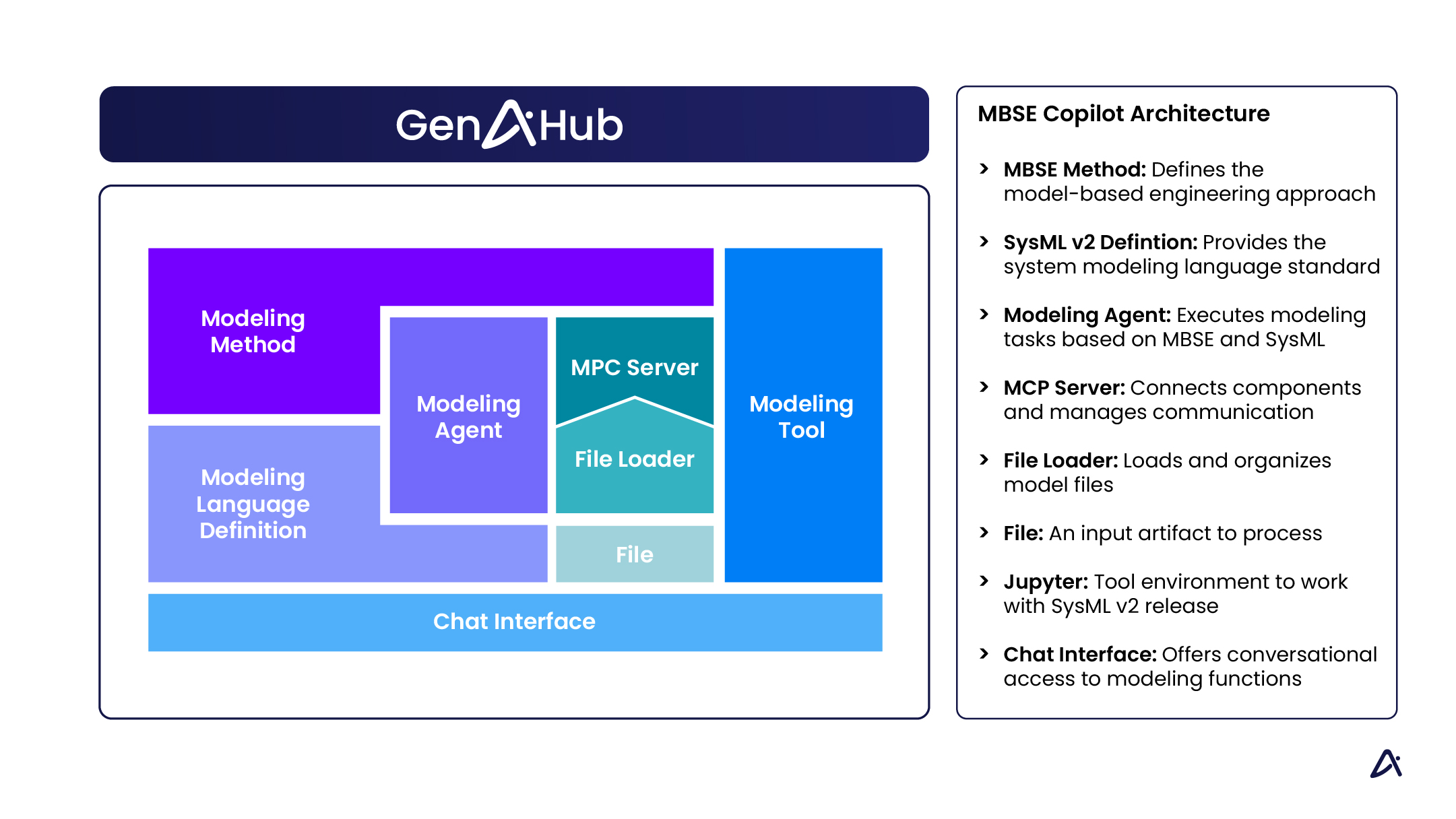
MCP is maturing toward enterprise readiness [14] with authentication, authorization, and audit trail capabilities on the roadmap. FEV’s architecture accounts for current gaps through layered security controls on its Kubernetes infrastructure, with LangFuse [12] providing agent-level observability across decisions, tool invocations, latency, and cost.
What Happened
In a reference engagement with a major US OEM, the Systems-as-Code approach was applied to hundreds of thousands of lines of legacy embedded powertrain software with no accompanying specifications. The result: a complete suite of ASPICE-compliant artifacts (requirements, architecture, detailed design, and verification records) with full V-model traceability, reducing engineering effort by an order of magnitude. (Specific metrics are withheld under client confidentiality.)
In a separate project with a German Tier 1 supplier, the MBSE CoPilot is deployed for automated pre-analysis model creation from textual specifications, with traceability reporting and methodology compliance built into the workflow.
These results sit against a broader industry backdrop. PLM vendors like Siemens, PTC, and Dassault Systemes are introducing copilots [7], but as industry observers note [6], these remain confined to single-tool silos with databases designed for GUI-driven workflows. FEV is building toward this gap through API adapters and structured extraction layers designed for foundation-model portability and incremental integration with legacy systems.
What’s Next
The tooling landscape will keep evolving: PLM vendors are adding AI, MCP is becoming the integration standard, and SysML v2 is enabling Systems-as-Code [9]. Organizations that build capability now gain a compound advantage. Those that wait risk the GenAI Divide [5] that MIT’s research has documented.
Data quality remains foundational. AI amplifies the quality of its inputs, making structured, well-governed engineering data a prerequisite for meaningful results. The systems engineer of tomorrow manages a team of specialized agents the way a lead engineer manages a development team today: setting direction, reviewing output, and ensuring quality across every artifact.
FEV serves as an AI guide across the organization, from C-level strategy on security and capabilities to engineering-level support on use-case validation and best practices.
FEV’s AI solutions for Systems Engineering are available to organizations seeking to accelerate MBSE adoption, recover legacy specifications, or deploy AI-assisted engineering workflows at scale.
Contact us to learn more: solutions@fev.io or directly at heinen_k@fev.io
Figures in this article were produced with AI image generation tools. Text drafting was assisted by large language models including Claude (Anthropic) and Gemini (Google DeepMind).
Standards & Research
1. CYEQT / BMW Security -UN R155 Worldwide: How Countries Regulate Vehicle Cybersecurity in 2025
2. European Commission -EU AI Act: Regulatory Framework for Artificial Intelligence
3. Hogan Lovells -EU Cyber Resilience Act: Key 2026 Milestones Toward CRA Compliance
4. Gartner -40% of Enterprise Apps Will Feature Task-Specific AI Agents by 2026 (Press Release, Aug 2025)
5. MIT NANDA -The GenAI Divide: State of AI in Business 2025 (PDF, Jul 2025)
8. INCOSE -What Is Systems Engineering?
10. Anthropic -2026 Agentic Coding Trends Report (PDF)
11. Linux Foundation / AAIF -Model Context Protocol: Open Standard for AI-Tool Integration
14. Model Context Protocol -2026 Roadmap: Transport Scalability, Enterprise Readiness, Agent Communication
Industry Commentary
6. Consilia Vektor -Why PLM Is the Last Category AI Agents Will Disrupt (Mar 2026)
7. Beyond PLM -Building PLM Agents: Why Everyone Is Announcing AI and Why Almost Everyone Is Missing the Point (Nov 2025)
9. SPK and Associates -Unifying MBSE and Software Development: GitLab Duo + SysML v2
12. LangFuse -Open Source LLM Engineering Platform
13. Stack Overflow Blog -Authentication and Authorization in Model Context Protocol (Jan 2026)
[1]: https://www.cyeqt.com/en/un-r155-worldwide-how-countries-regulate-vehicle-cybersecurity-in-2025/
[2]: https://digital-strategy.ec.europa.eu/en/policies/regulatory-framework-ai
[3]: https://www.hoganlovells.com/en/publications/eu-cyber-resilience-act-getting-ready-for-cra-compliance-in-2026
[4]: https://www.gartner.com/en/newsroom/press-releases/2025-08-26-gartner-predicts-40-percent-of-enterprise-apps-will-feature-task-specific-ai-agents-by-2026-up-from-less-than-5-percent-in-2025
[5]: https://nanda.media.mit.edu/ai_report_2025.pdf
[6]: https://www.consiliavektor.com/2026/03/09/why-plm-is-the-last-category-ai-agents-will-disrupt/
[7]: https://beyondplm.com/2025/11/22/building-plm-agents-why-everyone-is-announcing-ai-and-why-almost-everyone-is-missing-the-point/
[8]: https://www.incose.org/systems-engineering
[9]: https://www.spkaa.com/blog/unifying-mbse-and-software-development-gitlab-duo-sysml-v2
[10]: https://resources.anthropic.com/hubfs/2026%20Agentic%20Coding%20Trends%20Report.pdf
[11]: https://modelcontextprotocol.io/
[12]: https://langfuse.com/
[13]: https://stackoverflow.blog/2026/01/21/is-that-allowed-authentication-and-authorization-in-model-context-protocol/
[14]: https://modelcontextprotocol.io/development/roadmap