A part of FEV Group
Engineering Process Framework (EPF) – The Next Step Toward More Efficient Engineering
Author -
FEV.io
Published -
Reading time -
4 mins
A part of FEV Group
Author -
FEV.io
Published -
Reading time -
4 mins
Today’s engineering organizations face increasing pressure to leverage their valuable knowledge efficiently, make it accessible across global subsidiaries, and meet rising quality and compliance expectations. Despite having strong expertise, up to 40% of development costs are lost to troubleshooting, often because knowledge is not documented in a structured way or reused effectively. Many R&D teams solve the same problems repeatedly simply because they are unaware of existing know-how within the company. Delayed product launches, late design changes, and growing regulatory demands intensify this challenge. At the same time, the lack of an organized data foundation severely limits the effective use of AI, which is a reason only 1 in 20 companies experience a positive effect on their P&L – 95% fail scaling AI1.
Many organizations have attempted to adopt existing standards such as ASPICE, INCOSE, or commercial frameworks. Yet implementation frequently fails when faced with day-to-day realities: A “not-invented-here” mindset, misalignment with existing organizational workflows, overly generic guidance and lack of operational integration are reasons for it. ASPICE, for example, is an assessment model, not a process framework. It evaluates projects but does not build lasting organizational capability. INCOSE provides a strong theoretical baseline but is technology-neutral and requires extensive adaptation. The result is predictable: the theory exists, the implementation does not and the next project ends up just as chaotic as the last one.
EPF integrates three essential pillars into one cohesive, user-oriented approach:
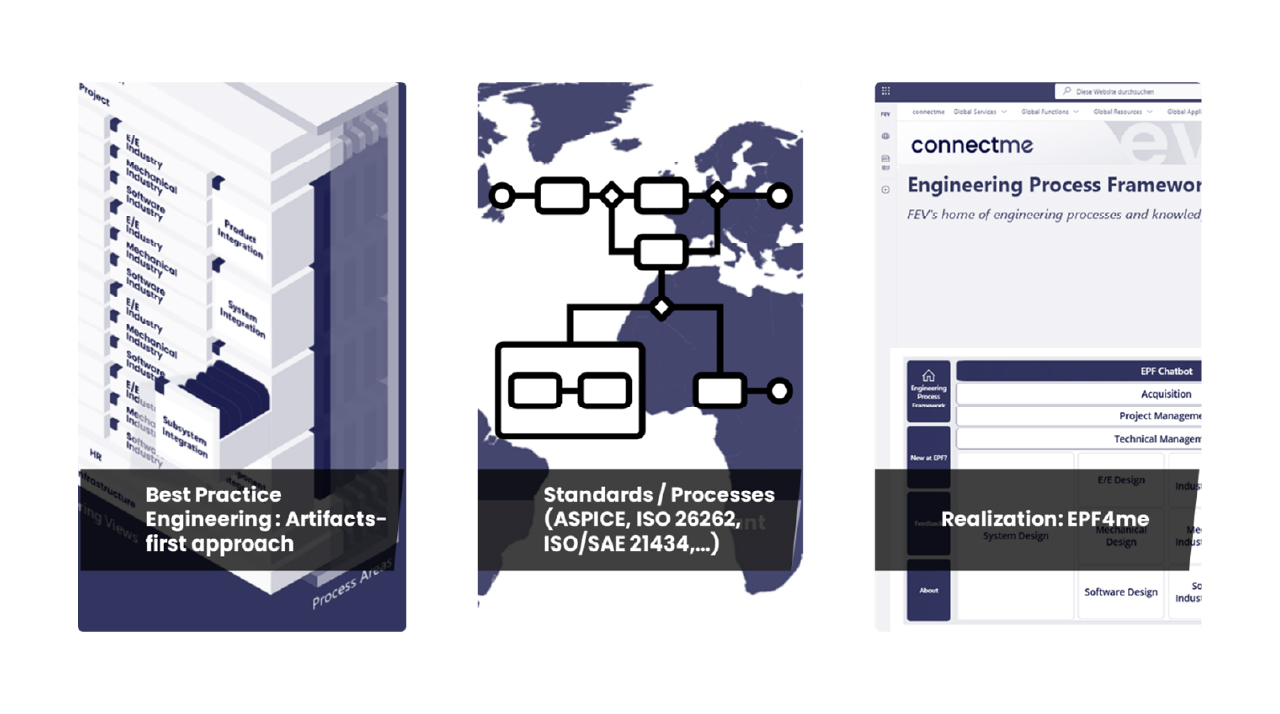
EPF is an all-in-one solution that integrates process development, methodology, organizational enablement, and assessments. It delivers:
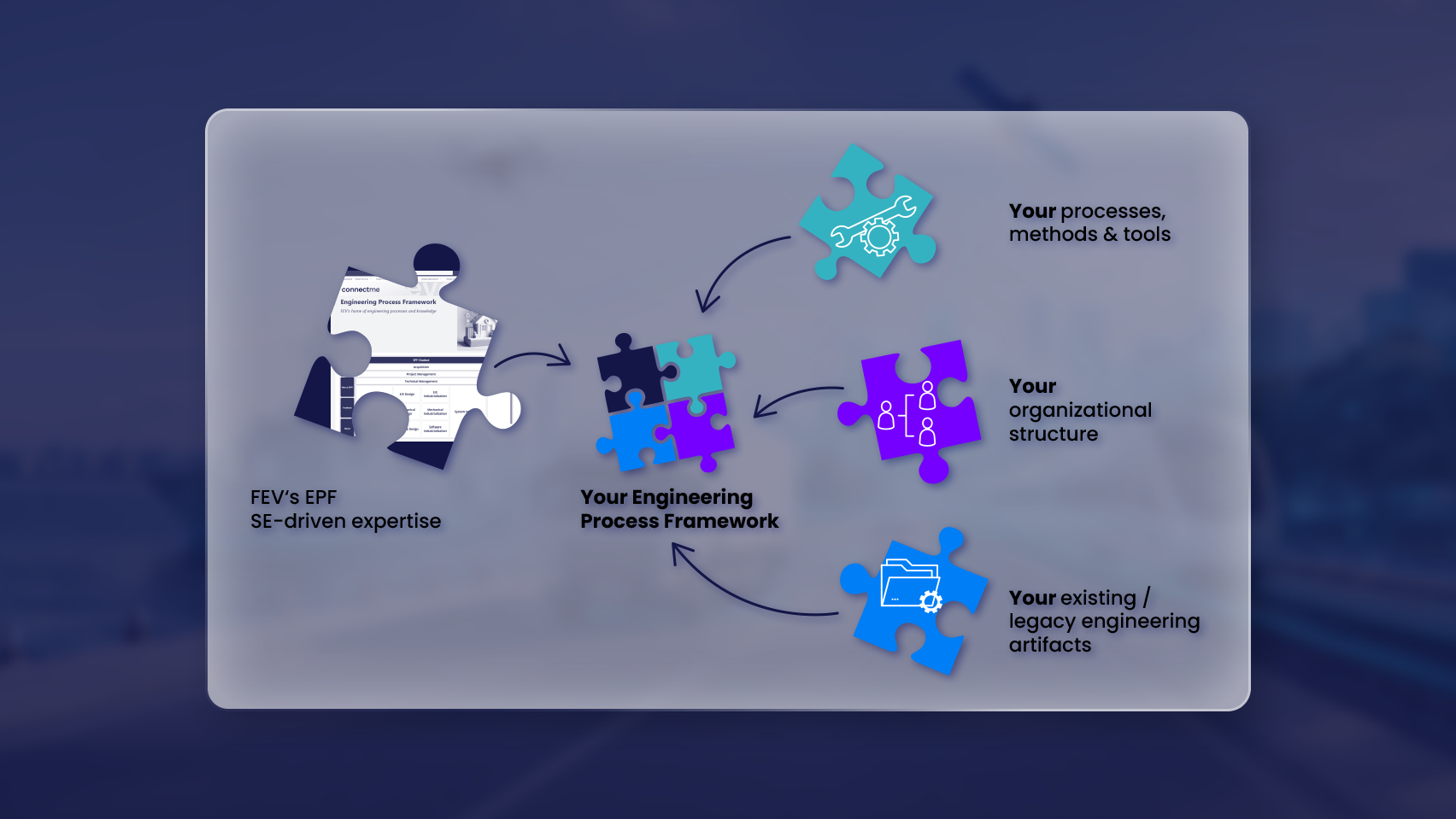
EPF is an integrated approach tailored to each customer. It brings together your existing artifacts and structures with FEV’s engineering expertise. It is not a one-size-fits-all template, but a customized framework designed for maximum impact.
Evaluations and project studies demonstrate clear efficiency gains:
The result is a tailored framework that leverages five decades of engineering expertise to significantly enhance efficiency, quality, and competitiveness. FEV supports organizations throughout their entire transformation journey by providing the EPF framework along with customizable process blueprints, offering process consulting from baseline analysis to target definition, and driving operational process and infrastructure development. In addition, certified FEV assessors conduct formal assessments to ensure transparency and measurable progress.
Interested in collaborating or learning more about EPF?
Get in touch with us at: solutions@fev.io or contact Christian Granrath or Jan-Jöran Gehrt.
1 Challapally, A., Pease, C., Raskar, R., Chari, P., “State of AI in Business 2025”, Version 0.1, Preliminary Findings from AI Implementation Research from Project NANDA, July 2025.
2 Gehrt, J., Granrath, C., Caglayan, E., Reckeweg, T., et al., “Structuring Cross-Disciplinary Development: A Systems Engineering Framework for ASPICE-Compliant Mechatronic and Cyber-Physical Engineering,” SAE Technical Paper Series, January 1, 2026, https://doi.org/10.4271/2026-01-5025.
3 Richenhagen, J., et al. “E/E industrialization with MBSE for Series Development of Software Defined Vehicles.” 32nd Aachen Colloquium Sustainable Mobility. 2023.