A part of FEV Group
Humanoid Robotics at FEV: The FEV Bot Innovation Program
Author -
FEV.io / FEV Consulting
Published -
Reading time -
4 mins
A part of FEV Group
Author -
FEV.io / FEV Consulting
Published -
Reading time -
4 mins
A key activity in FEV’s journey toward becoming the leading engineering service provider in advanced robotics is our ongoing innovation program “FEV Bot”. In this newsletter, we provide a status update on the two projects “Software for Use Cases” and “Safety Layer & Deployment.”
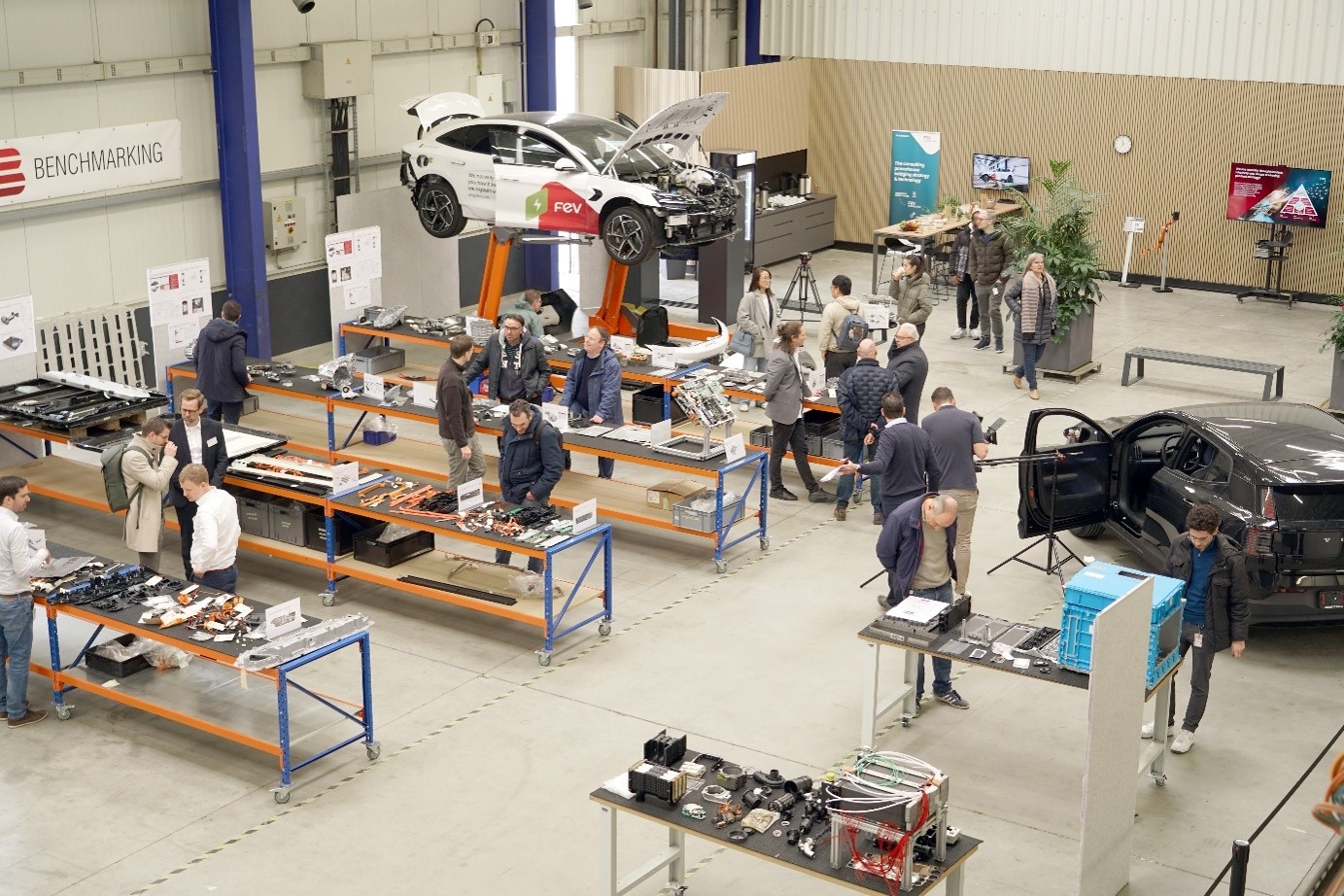
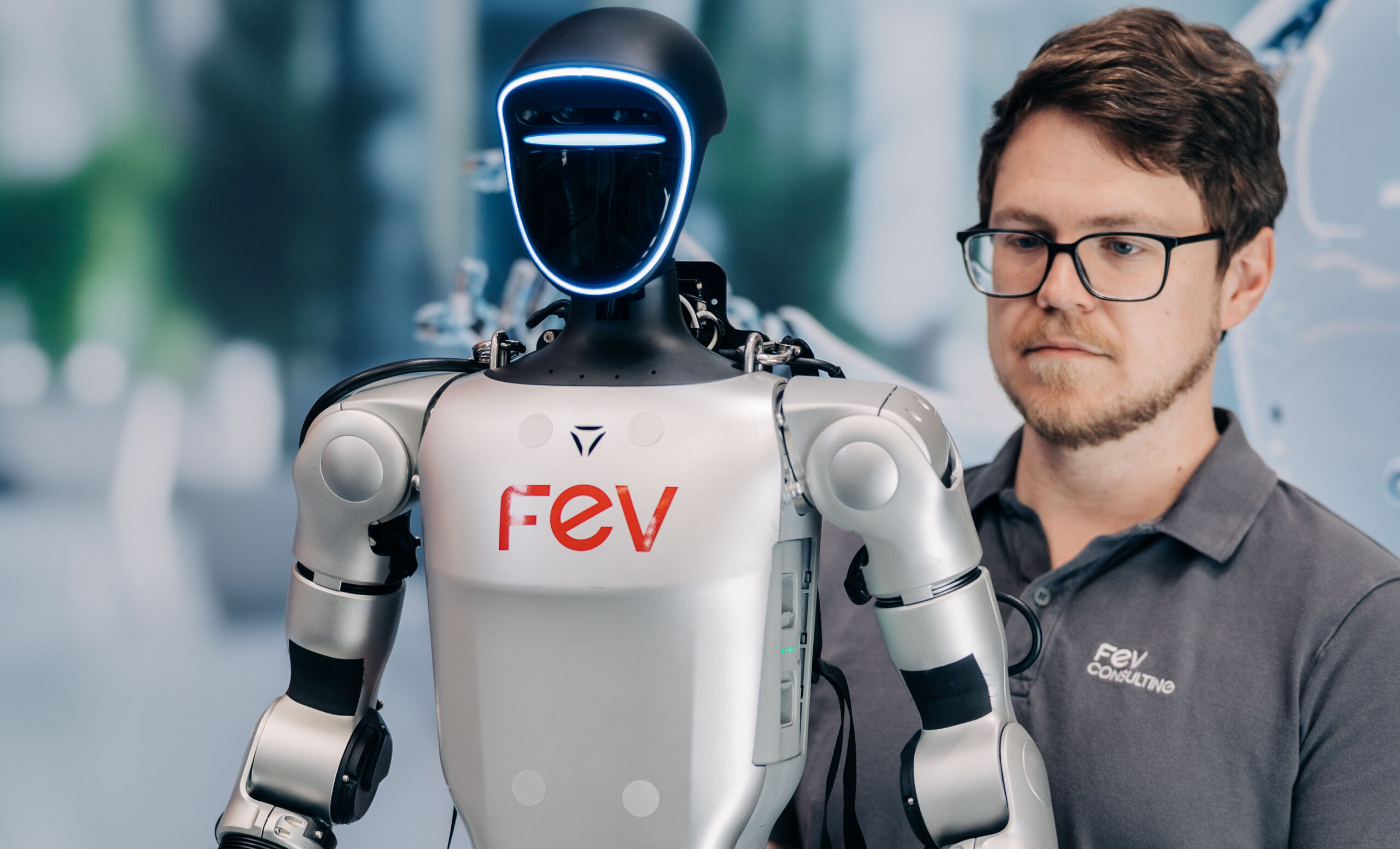
Our main objective is to establish an efficient process for enabling our Unitree G1 humanoid robot to safely execute dedicated use cases. The robot is intended to perform tasks in environments with potential human bystanders while also interacting directly with people. Examples of the use cases under consideration include guiding visitors through an exhibition area (e.g., our Benchmark Center in Aachen, Figure 1) and picking and placing objects in a production facility.
Such applications are highly relevant from a functional safety perspective, as the Unitree G1 is capable of generating considerable forces, and any malfunction could result in harm to nearby individuals. Additional hazardous scenarios include the robot stumbling and falling, potentially striking bystanders, or the acceptance of voice commands that could lead to unintended or malicious behavior.
We operate the Unitree G1 in the so-called Robot Gym at our Aachen headquarters (Figure 2). Here, we integrate the software stack developed by a team of software experts at FEV India. The FEV India team is developing a safety-aware and customizable software stack for the Interactive Presentation with Locomotion and Manipulation use case. The development follows a systematic systems engineering approach. The use case, requirements, architecture, interfaces, safety needs, and validation methods are defined before implementation.
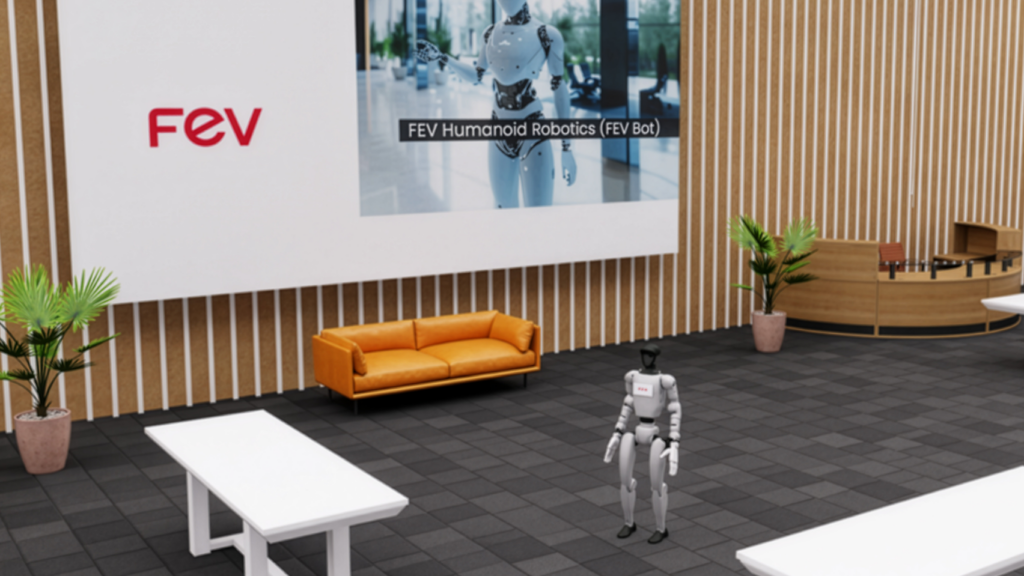
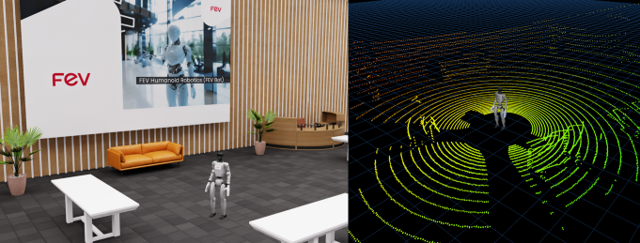
A simulation-first approach is used to develop and test robotic functions. Digital twins of the Unitree G1 robot and the Robot Gym environment are created in NVIDIA Isaac Sim (Figure 3). The digital twin is extensively tested in the simulation environment that reproduces the Robot Gym in Aachen (Figure 4). The simulation includes the robot’s sensors, actuators, control interfaces, navigation functions, and interaction with the environment.
The software stack combines navigation, manipulation, perception, interaction, task orchestration, diagnostics, and operational safety functions. An LLM-based brain supports natural interaction with visitors. It helps the robot understand questions, provide suitable responses, and select the next action. Dynamic decision-making allows the robot to react to visitor requests, environmental changes, system conditions, and unexpected situations.
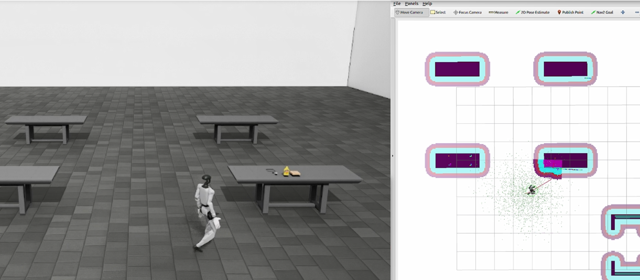
Through virtual testing, new functionalities are pre-validated before being handed over to the team in Aachen, which performs the final verification and validation in the Robot Gym using the physical Unitree G1. This approach has already proven to be highly efficient, primarily due to the strong correlation between simulation and real-world performance, the near-continuous development pipeline enabled by the time zone difference between India and Germany, and the cost savings achieved by avoiding the purchase of a second robot.
To develop the functional safety concept, we have completed the initial activities defined in accordance with the established standard ISO 26262 for the functional safety of road vehicles, as the corresponding robotics-specific standard ISO 25785 is still under development. Although ISO 26262 focuses on road vehicles, many of its fundamental objectives and processes can be applied to humanoid robots. We began with an item definition, which served as the basis for a Hazard Analysis and Risk Assessment (HARA). Based on the findings of the HARA, we derived safety goals as high-level requirements.
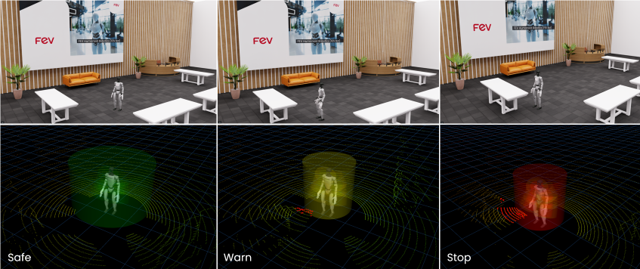
In the next phase, these requirements will be refined and subsequently implemented within a dedicated Safety Wrapper. As part of the safety concept, the robot continuously detects people and objects in its surroundings and evaluates their distance from its operating area. Based on the detected risk, it can continue safely, issue a warning, slow down, or stop to protect nearby people (Figure 5).
Watch out for upcoming newsletters about further progress in our exciting innovation program!
Meet us at ARC 2026 (25–26 November, Aachen, Germany) to experience live robot demonstrations, connect with the robotics ecosystem, and discover our latest advancements in humanoid robotics.