A part of FEV Group
FEVIntelliGen – Systems Engineering with AI
Author -
FEV India
Published -
Reading time -
5 mins
A part of FEV Group
Author -
FEV India
Published -
Reading time -
5 mins

In modern product development, AI Systems Engineering transforms engineering inputs into connected artifacts through a modular GenAI workflow. FEV IntelliGen transforms engineering inputs into connected Systems Engineering artifacts through a modular, multi-agent GenAI workflow. Organizations can use an individual generation module or combine modules into an end-to-end package, with review and traceability integrated throughout the journey.
Modular GenAI workflow · Connected engineering artifacts · Review and traceability integrated
Systems Engineering teams must interpret customer inputs, standards, guidelines, templates and existing engineering knowledge before creating multiple downstream work products. When this transformation is performed manually, teams spend valuable engineering capacity on repetitive documentation, while maintaining consistency, completeness and traceability across artifacts becomes increasingly difficult as project complexity grows.
The problem IntelliGen addresses: Reducing the manual effort required to transform diverse engineering inputs into a connected chain of feature descriptions, functions and use cases, stakeholder requirements and system requirements, without losing engineering review, governance or traceability.
IntelliGen is designed for environments in which structured Systems Engineering and traceable artifact development are essential. The approach can support automotive, rail, off-highway, marine and defense contexts, while allowing domain-specific standards, templates, guidelines and knowledge sources to shape the generated outputs.
Adaptable to the engineering context: common workflow principles can be combined with customer-specific and domain-specific knowledge to support different products, organizations and development environments.
FEV IntelliGen uses specialized agents and approved engineering knowledge sources to generate selected Systems Engineering artifacts, support staged review and preserve relationships between upstream and downstream outputs.
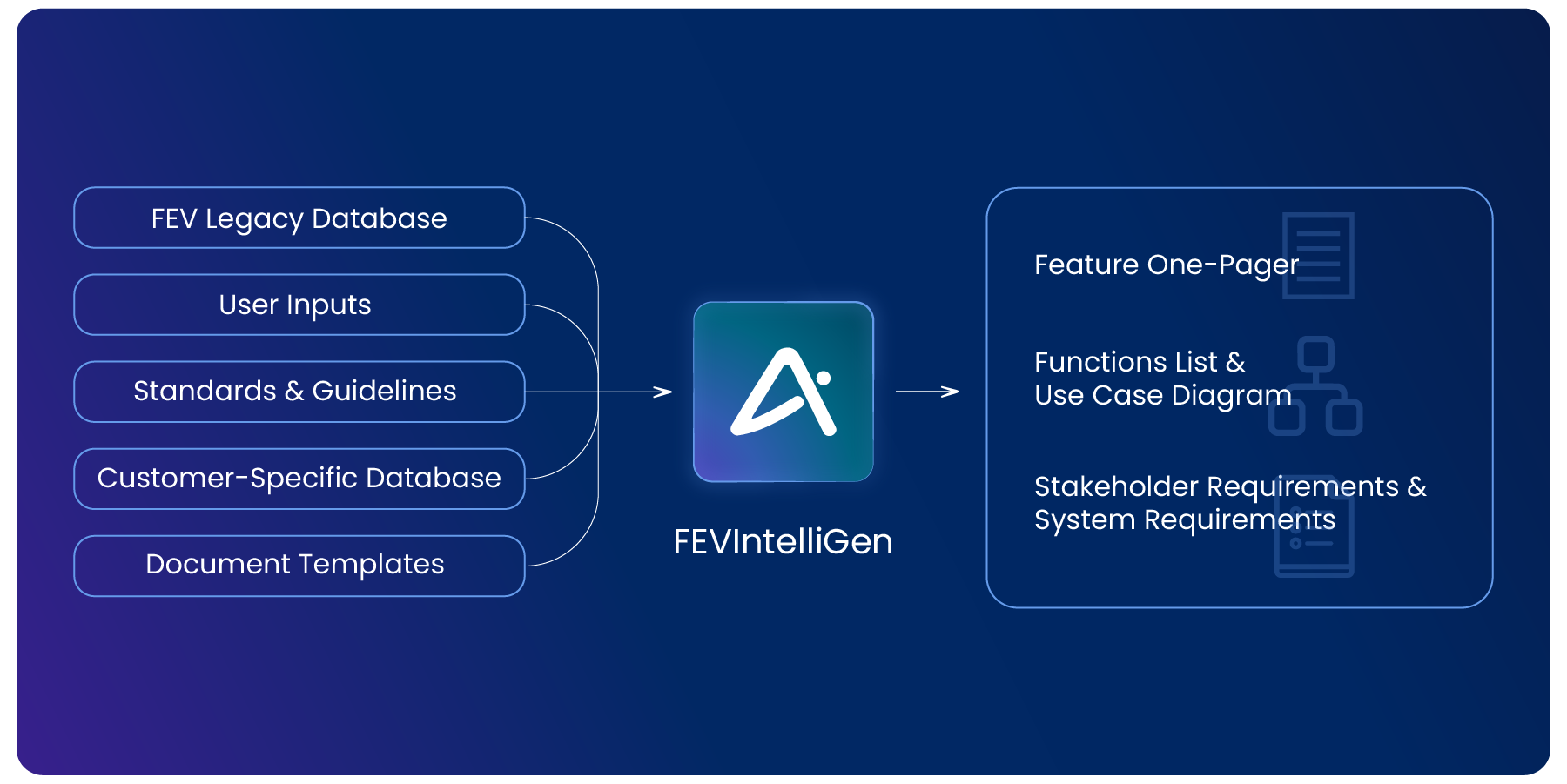
IntelliGen can be applied to a specific engineering artifact or configured as an integrated workflow across the complete artifact chain. This allows organizations to begin with a focused use case and expand as their needs evolve.
The workflow brings together user input, standards and guidelines, document templates, and optional FEV or customer-specific knowledge sources. Specialized generation stages create individual artifacts, while supervising agents and expert feedback support iterative refinement.
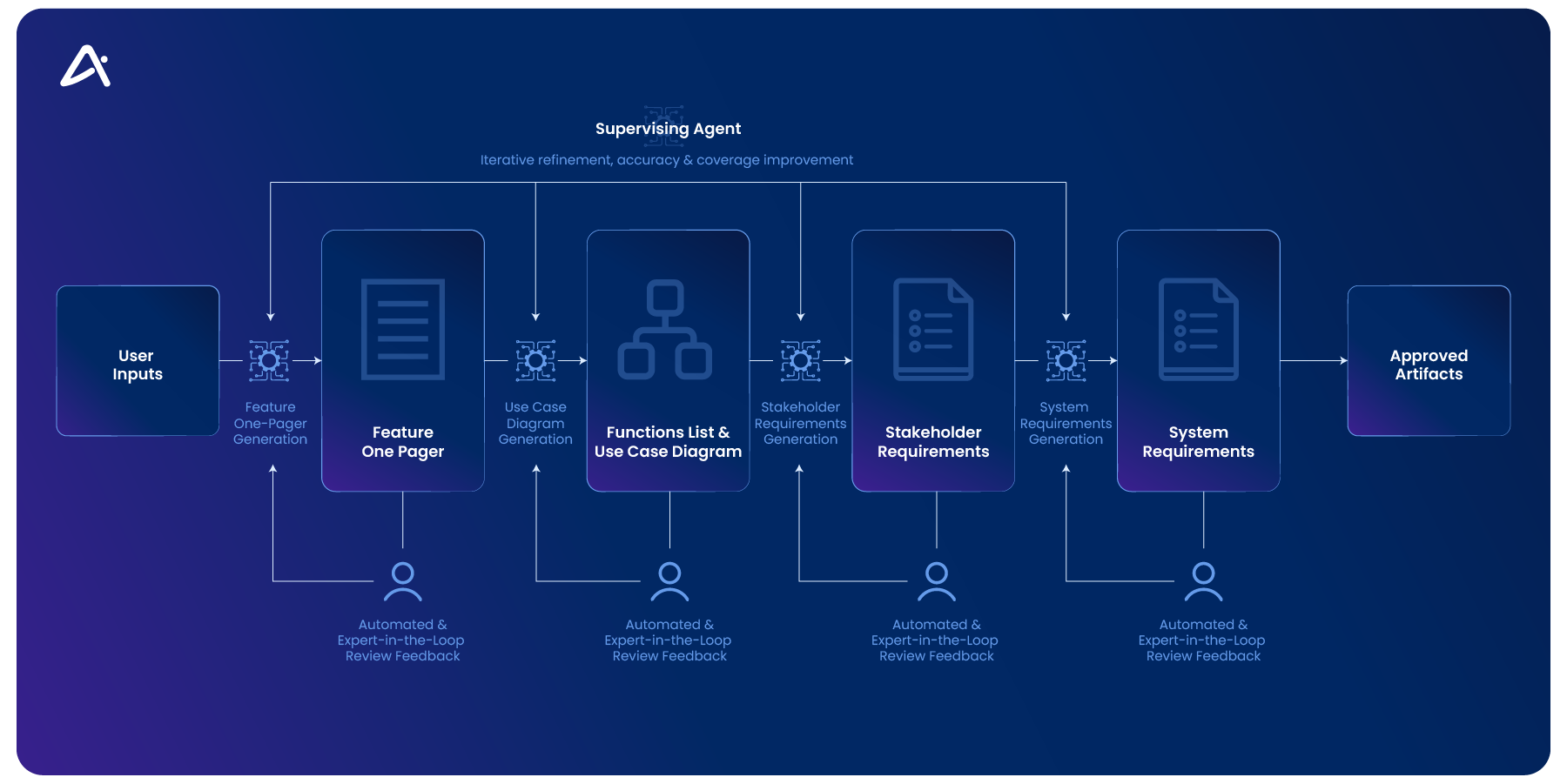
IntelliGen is intended to reduce effort spent on repetitive artifact creation, improving overall AI Systems Engineering workflows and helping teams focus more of their capacity on analysis, decisions and validation. The realized impact depends on the selected modules, input quality, workflow scope and customer environment.
IntelliGen supports import, export and downstream workflows with standard industry PLM, ALM and requirements-management toolchains. Generated artifacts remain usable within the customer’s established engineering lifecycle, processes and governance environment.
Interoperability principle: generated artifacts should remain usable within modern AI Systems Engineering environments and established customer tool landscapes.
Start with the IntelliGen product that addresses the highest-value engineering bottleneck, or connect the modules into a complete, traceable Systems Engineering workflow.
To discuss custom integration, explore domain-specific use cases, or request a tailored pilot, get in touch with our experts Piyush Burangi and Kartik Daware.
Contact: solutions@FEV.io