A part of FEV Group
CCAM Scenarios: From Past to Practice
Author -
FEV.io
Published -
Reading time -
5 mins
A part of FEV Group
Author -
FEV.io
Published -
Reading time -
5 mins
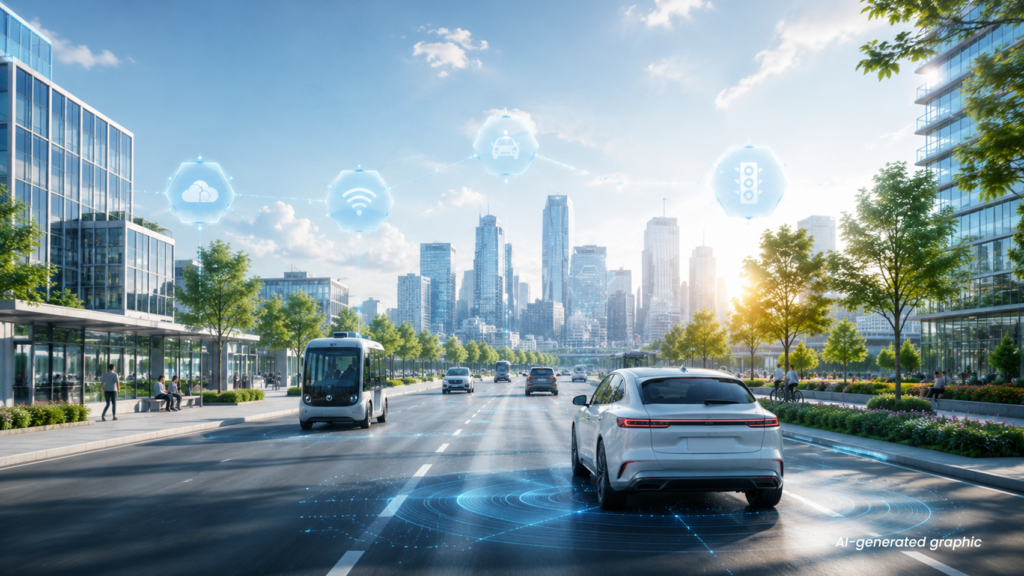
Connected, Cooperative and Automated Mobility (CCAM) represents a paradigm shift in modern transportation systems, integrating automation, connectivity, and cooperation among vehicles and infrastructure. Due to the complexity and safety-critical nature of automated driving systems, traditional validation approaches based on real-world testing have proven insufficient. Consequently, scenario-based methods have emerged as a structured and scalable alternative. A central concept in CCAM development is the scenario, defined as a time-sequenced representation of traffic scenes including actors, environmental conditions, and their interactions. In this context, CCAM scenarios play a crucial role in enabling systematic and repeatable validation. [taxonomy.c…driving.eu]
Over the past fifteen years, scenario-based approaches have become a key methodology for the development, testing, and validation of CCAM systems. During this time FEV.io GmbH has participated to numerous EU funded projects, for example L3Pilot, HiDrive and Synergies, which significantly pushed the development of CCAM features to new levels. FEV.io accompanied the evolution of CCAM scenarios definition from early rule-based representations to modern data-driven and AI-supported frameworks.
In the early 2010s, validation of automated driving systems primarily relied on extensive real-world driving tests. However, such methods were ineffective in capturing rare but safety-critical events and required substantial time and cost. [arxiv.org]
To address these limitations, researchers introduced scenario abstraction techniques based on expert knowledge, accident databases, and naturalistic driving data. These early scenarios were typically rule-based and static, focusing on representative driving situations rather than systematic coverage of the entire operational design domain.
Between 2015 and 2020, scenario development gained structure through large-scale research initiatives and standardization efforts. The ERTRAC CCAM Roadmap introduced key use-case domains such as highways, urban environments, and rural roads, enabling systematic classification of driving scenarios. [connecteda…driving.eu]
During this period, scenario-based testing emerged as a fundamental validation paradigm. By abstracting real traffic into parameterized and repeatable scenarios, developers were able to systematically test safety-critical conditions and reduce testing effort. [ika.rwth-aachen.de]
During the time of L3Pilot project (www.l3Pilot.eu from September 2017 till August 2021) FEV.io GmbH supported with an autonomous highway traffic jam chauffeur and has tested traffic jam driving up to 60 kph in real world and simulation in the area around Aachen, Cologne and Düsseldorf.
The early 2020s marked a transition to data-driven scenario generation and large-scale simulation. Researchers increasingly combined naturalistic driving data with synthetic scenarios generated through simulation to enhance realism and coverage. [cambridge.org]
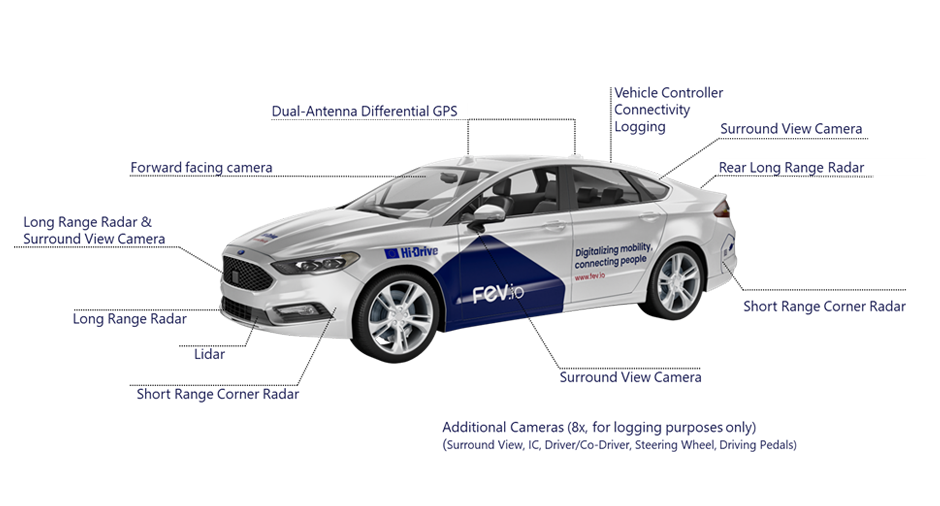
Simultaneously, scenario databases were introduced to enable data sharing and reuse across projects, supporting reproducibility and collaboration. Scenario-based validation expanded toward system-level assessment, addressing the full perception–decision–control chain in automated driving systems. [mdpi.com] This phase established the technological foundation for scalable and systematic validation frameworks. Within the HiDrive project FEV.io GmbH supported with an enhanced driving function for highway driving with vehicle to vehicle (V2V) communication support for on-ramp scenarios. For this kind of development FEV.io prepared a showcase for scenario-based development and standardized systems engineering framework and the possibility to generate automatically scenarios from SysMl models as well as Ai generated test cases for simulation usage. Outcome of this project together with our partners was a further developed IEEE use case with enhanced functionality for on-ramp driving with V2V support.
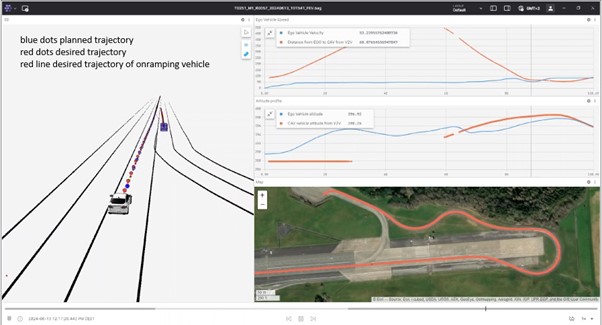
With the help of extensive testing with 2 other partners the function was developed for easing the merge in for on-ramp areas including fundamental analysis for V2V communication for these situations.
Recent advancements focus on the integration of artificial intelligence and federated data infrastructures. AI-based methods, including generative models and large language models, are now used to automatically generate diverse and safety-critical scenarios from operational design domain descriptions. [mdpi.com]
Scenario-based validation is now widely recognized as essential for the safety assurance and certification of CCAM systems.
The evolution of CCAM scenarios over the past fifteen years reflects a shift from empirical testing toward structured, data-driven validation methodologies. Scenario development has progressed from simple rule-based descriptions to advanced, AI-supported ecosystems with large-scale data integration.
Now FEV.io goes on with the scenario-based testing and development and supports the pre-LSDemo EU funded project, where the foundation of the LSDemo project will be prepared.
The continuous development and strategic preparation for future requirements at FEV.io remain an ongoing and evolving process, ensuring that the company consistently maintains the appropriate expertise in autonomous driving, verification, testing, software development, system integration, EE integration, safety, cybersecurity, and systems engineering to support the end-to-end development of autonomous driving and CCAM-related functions.
Get in touch with us to explore how FEV.io can support your CCAM development and validation needs: solutions@fev.io
[1] FAME Taxonomy, “Scenario Definition in CCAM,” 2025. [taxonomy.c…driving.eu]
[2] J. Zhou et al., “Automated Driving Systems Test Scenario Generation: A Review,” 2025. [arxiv.org]
[3] ERTRAC, “Connected, Cooperative and Automated Mobility Roadmap,” 2022. [connecteda…driving.eu]
[4] SYNERGIES Project, “Scenario-Based Validation for CCAM Systems,” European Commission, 2024. [cordis.europa.eu]
[5] A. Hossain, “Scenario Generation for Autonomous Driving: A Survey,” 2025. [cambridge.org]
[6] A. Ji et al., “Cooperative Connected and Automated Mobility: A Survey,” Future Transportation, 2026. [mdpi.com]
[7] A. A. Danso and U. Büker, “Automated Scenario Generation Using LLMs,” Electronics, 2025. [mdpi.com]
[8] www.l3pilot.eu EU funded project main homepage, may 2026
[9] www.pre-lsdemo-eu EU funded project homepage, may 2026
[10] https://synergies-ccam.eu/ EU funded project homepage, may 2026