A part of FEV Group
From Regulation to Evidence: Making Virtual Validation Credible for Automated Driving
Author -
FEV.io
Published -
Reading time -
4 mins
A part of FEV Group
Author -
FEV.io
Published -
Reading time -
4 mins
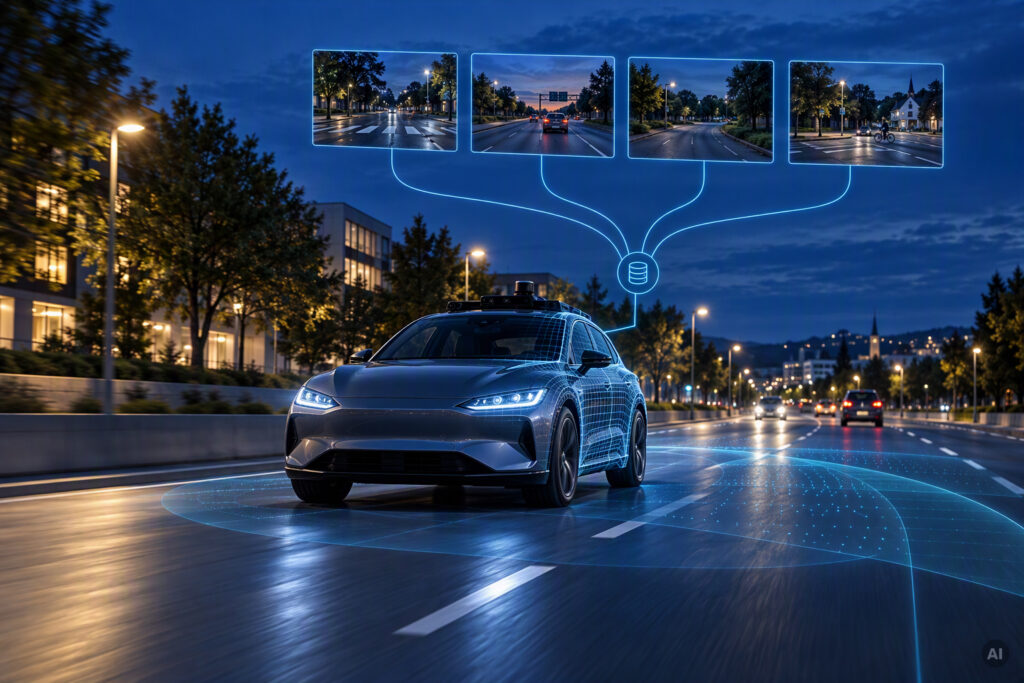
Virtual testing has become essential for developing and validating automated driving functions because the scenario space cannot be addressed through physical testing alone. European regulation recognizes this: EU 2022/1426 allows virtual testing to contribute to automated driving system (ADS) type approval and defines, together with UN Regulation No. 171, the key areas for assessing simulation credibility. Yet translating these regulatory expectations into concrete activities, responsibilities and evidence remains an engineering challenge, due to ever-changing simulation technologies and application demands.
At ELIV 2026, we showed how FEV.io addresses this gap with credibility assessment workflow – designed with Systems Engineering principles – that can be tailored to different simulation toolchains while retaining regulatory traceability. Applying this workflow enabled us to assess simulation setups for testing VLA-based automated driving functions. Finally, we showed how regulatory traceability can be designed directly into scenario-generation tooling.
We treat the credibility assessment itself as a System of Interest (SoI). Regulatory requirements are translated into activities, inputs and outputs, roles and evidence, while dependencies and chronology are captured explicitly. The result is a reusable, plannable and traceable assessment workflow that can be tailored to concrete simulation toolchains without losing the link back to regulation. A reference simulation architecture framework then connects these activities to assessable components. The workflow’s formal structure also creates a foundation for agentic automation.
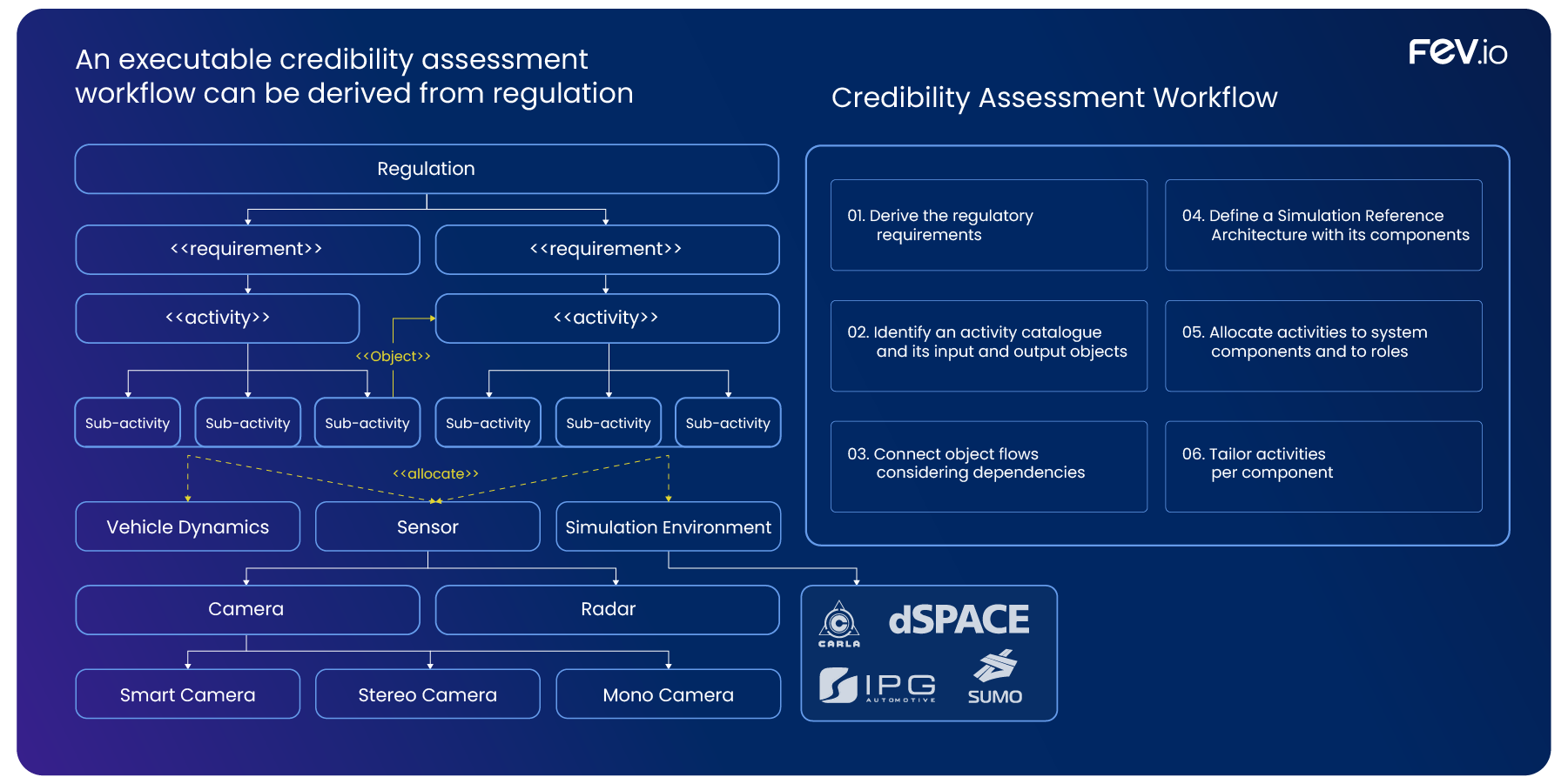
To test whether the workflow transfers to emerging technologies, we applied it to a simulation framework suitable for testing VLA-based AD functions. In our setup, the FEV “CarNuMayo bridge” connects CARLA, NVIDIA NuRec and NVIDIA Alpamayo in a closed-loop simulation. Because the VLA model acts directly on rendered camera inputs, the image stream and the components reconstructing and rendering it become assessment-relevant parts of the evidence chain. For NuRec specifically, this means allocating assessment activities to its sub-components to produce evidence artifacts like reconstruction configuration, hyperparameters, epoch counts, termination information and loss history for the render service, as well as Peak Signal-to-Noise Ratio (PSNR) for the NuRec Reconstructor.
The important finding: the technology changes, but the fundamental assessment workflow does not. Activities can be allocated and tailored to the relevant NuRec components using their available evidence artifacts. This allows the credibility assessment to evolve with new simulation technologies without requiring an entirely new assessment methodology.
Our assessment workflow also influences how simulation tools are designed. The LLM-assisted FEV.io Test Scenario Generator converts an OpenDRIVE road network, regulatory information and test configuration into ready-to-run OpenSCENARIO test cases. Generated scenarios are checked for logical consistency on triggers and maneuvers. A traceability matrix provides transparency about requirements that can and cannot be covered by the available road network.
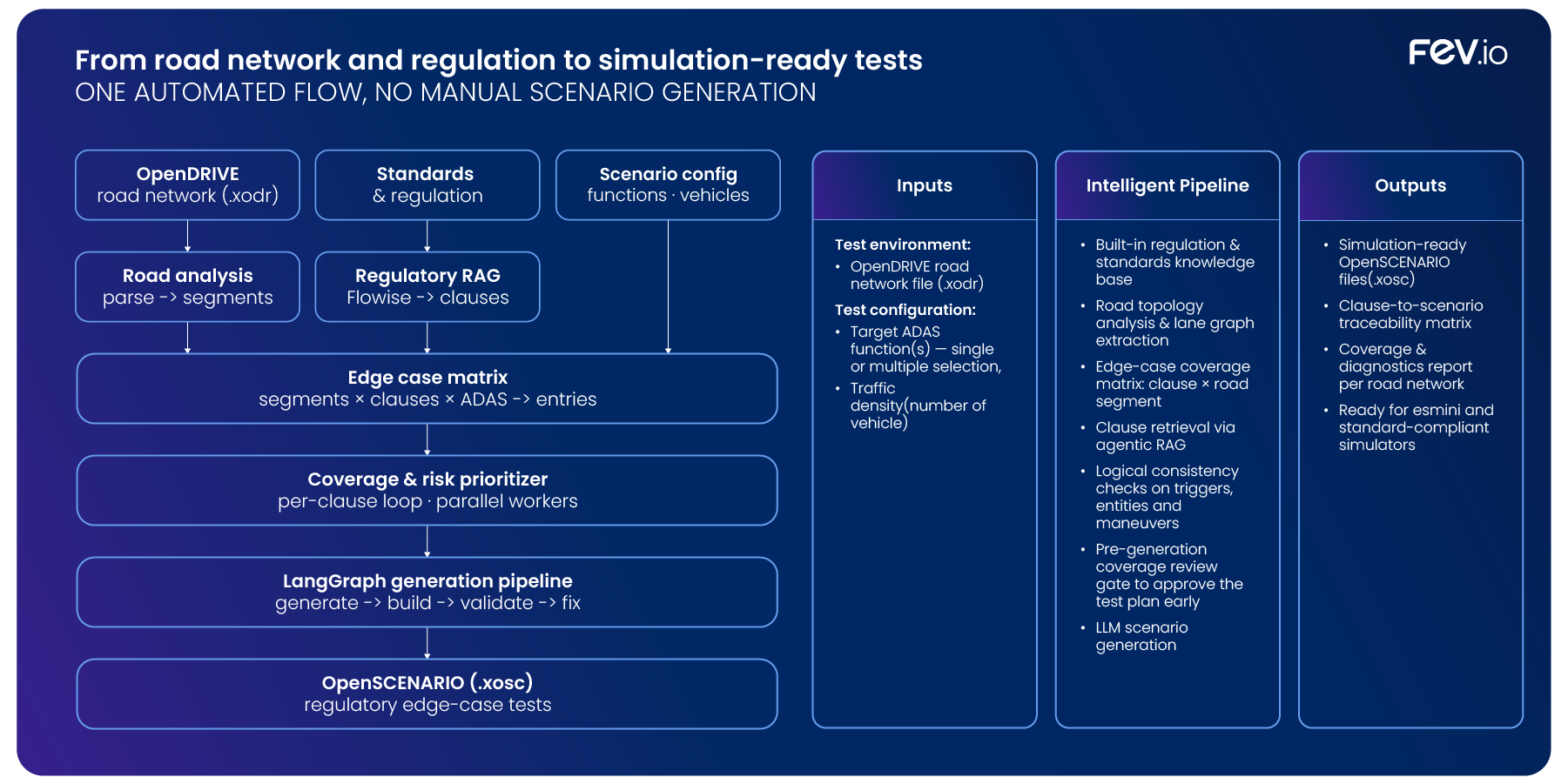
From regulation to evidence, our goal is to make credibility assessment an executable engineering workflow rather than a final checklist. Systems Engineering provides the structure to retain regulatory traceability while tailoring the assessment to different toolchains. The VLA application shows how this approach transfers to emerging simulation technologies, while the FEV.io Test Scenario Generator demonstrates how regulatory traceability can be embedded directly into the tools themselves. Together, these examples demonstrate how virtual validation becomes more reusable, plannable, transparent, and increasingly automatable.