A part of FEV Group
Functional Safety for AI in Autonomous Rover Navigation
Author -
FEV etamax
Published -
Reading time -
3 mins
A part of FEV Group
Author -
FEV etamax
Published -
Reading time -
3 mins
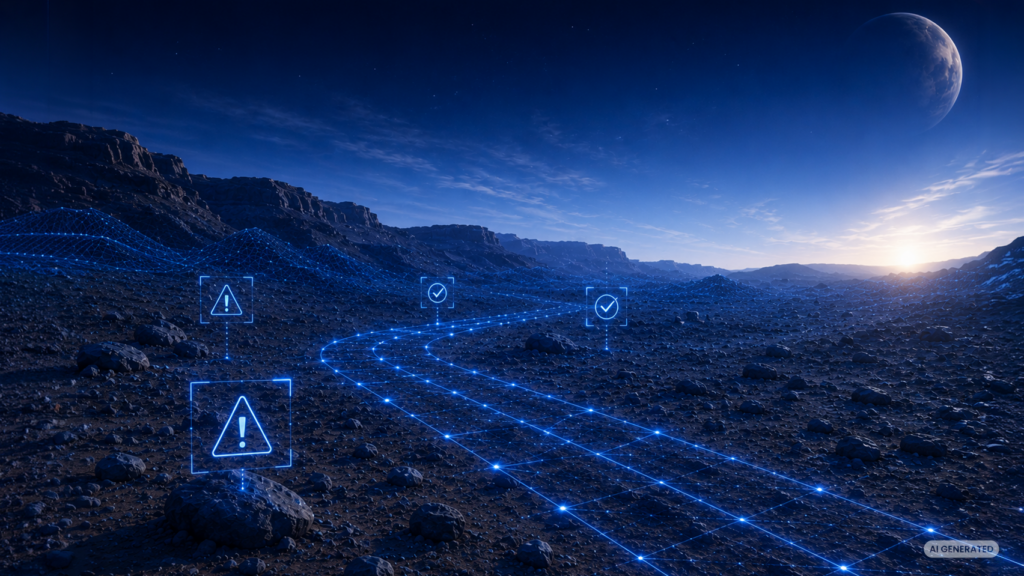
Space exploration pushes autonomous systems to their limits. Unlike vehicles on Earth, planetary rovers must operate without infrastructure, under extreme environmental conditions, and with communication delays that make real-time human intervention impossible. Every navigation decision must therefore be made safely and independently on-board.
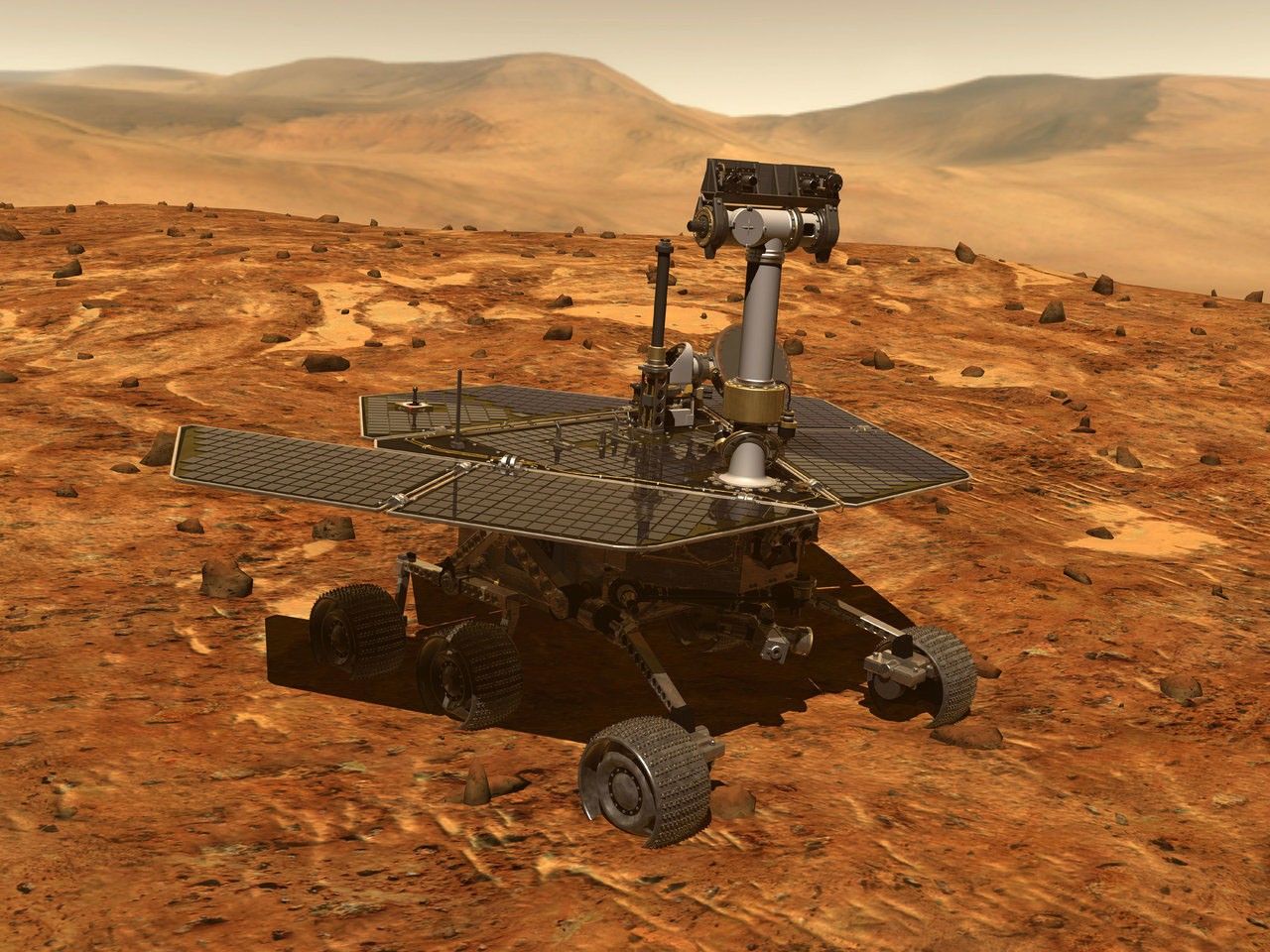
One of the most prominent examples is NASA’s Mars rover Spirit, which became permanently immobilized after getting stuck in soft Martian soil. Despite extensive recovery efforts, the rover was unable to free itself. The incident highlighted how challenging terrain assessment can be in planetary exploration and why robust, safety-oriented decision-making is essential for autonomous rover navigation.
Incidents like this demonstrate that planetary exploration is not simply about achieving the highest possible AI accuracy. Autonomous systems must reliably distinguish traversable terrain from hazards—even under conditions they have never encountered before.
Traditional AI development often focuses on metrics such as accuracy or Intersection over Union (IoU). While these are valuable indicators of model performance, they are not sufficient for safety-critical applications.
The real question is no longer:
How accurate is the model?
but rather:
How safe is its decision under uncertainty?
For planetary exploration, out-of-distribution data—terrain that differs from anything seen during training—is the norm rather than the exception. Combined with limited labeled datasets, varying lighting conditions, changing surface characteristics, and constrained onboard hardware, autonomous systems must be able to recognize not only hazards but also the limits of their own knowledge.
A trustworthy AI system must know when it does not know.
At FEV etamax, we are combining proven Functional Safety methodologies with modern AI to develop a safety-focused approach for autonomous rover navigation.
Our research includes:
Rather than optimizing solely for accuracy, this approach focuses on building AI systems that remain dependable when operating in unknown and unpredictable environments.
Although this work is motivated by space exploration, the underlying methodology extends far beyond rover navigation.
The combination of Functional Safety, trustworthy AI, and uncertainty-aware decision-making is highly relevant for other safety-critical domains where autonomous systems must operate reliably under uncertainty. These include automotive, aerospace, rail, defense, and other regulated industries.
By transferring established safety engineering principles into modern AI development, FEV etamax is helping shape the next generation of dependable autonomous systems—whether they navigate roads, railways, aircraft, or the surface of another planet.
This research also lays the foundation for future collaboration with organizations such as the European Space Agency (ESA), the German Aerospace Center (DLR), industrial partners, and OEMs.
By bringing together expertise from Functional Safety, AI, and software engineering, FEV etamax continues to develop technologies that enable reliable autonomy—even in the most demanding environments.